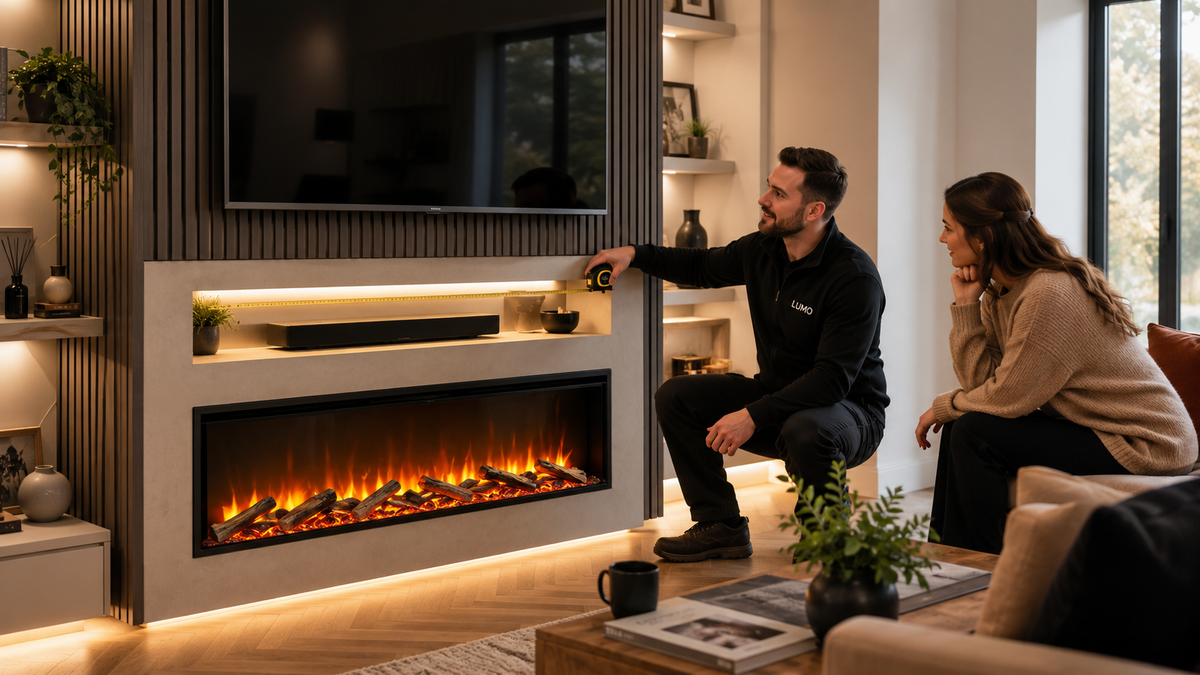
Electric Fire Installation: What to Check Before Ordering
Electric Fire Installation: What to Check Before Ordering
Ordering an electric fire is exciting, especially if you are planning a new media wall, fireplace upgrade or feature wall.
But before you choose the model, size or style, there are a few things worth checking first.
This is exactly the kind of advice we would give you in the showroom before you order. Not to make the process complicated, but to help you avoid the common mistakes.
The right fire needs to suit the room, the wall, the installation type and the finished look you want.
A little planning at the start can save a lot of hassle later.
Quick answer
Before ordering an electric fire, check the wall width, available depth, power access, installation type, TV position, clearances, ventilation requirements and finished room layout.
You should also check whether the fire is designed to be wall-mounted, inset, built into a media wall, fitted into a fireplace opening, or installed as a one, two or three-sided feature.
If you are unsure, it is always better to send your wall measurements, room photos and preferred style before ordering.
The easiest way to think about electric fire installation is this:
Do not start with the fire.
Start with the room.
Look at where the fire is going, how much space you have, how deep the wall can be, where the power will come from, and what you want the finished wall to look like.
Once those parts are clear, choosing the right fire becomes much easier.
1. Check the wall width
The first thing to check is the wall width.
This sounds obvious, but it is one of the most important details.
A fire can look too small if the wall is very wide. It can also look too large if it is squeezed into a narrow space with no breathing room around it.
For media walls, you should also think about the width of the TV, shelving, side panels and any built-in storage.
A good fireplace layout should feel balanced. The fire should suit the wall, not fight with it.
Before ordering, measure:
-
Full wall width
-
Planned chimney breast or media wall width
-
TV width
-
Space either side of the fire
-
Any shelving or cabinet areas
-
Distance from corners, doors or windows
If you are unsure between two fire sizes, the room layout usually makes the decision easier.
2. Check the available depth
Depth is just as important as width.
Some electric fires are slimline and designed for shallower installations. Others are deeper and need more space behind the wall.
Before ordering, check how much depth you have available.
This matters especially if you are building:
-
A media wall
-
A false chimney breast
-
A recessed feature wall
-
A fireplace opening
-
A wall-mounted layout
If the room is narrow, you may not want to build the wall too far forward. In that case, a slimline fire can make more sense.
If you have the space and want a stronger, more premium fire presence, a deeper fire may be a better option.
3. Decide how you want the fire installed
Different electric fires are designed for different installation styles.
Some are made to hang on the wall. Some are designed to be recessed. Some can be built into a media wall. Some suit fireplace openings. Some can be installed as one, two or three-sided designs.
Before ordering, decide which look you want.
Common options include:
-
Wall-mounted electric fire
-
Fully recessed electric fire
-
Built-in media wall fire
-
One-sided installation
-
Two-sided corner installation
-
Three-sided panoramic installation
This is important because not every fire suits every installation type.
If you want a clean built-in look, make sure the fire is designed for that kind of installation.
4. Check the power access
Electric fires need safe access to power.
Before ordering, think about where the socket or fused spur will be positioned and whether it will remain accessible after installation.
For many built-in fires and media wall projects, your electrician or installer may need to plan the power point before the wall is closed up.
You should check:
-
Where the power cable exits the fire
-
Whether a socket or fused spur is needed
-
Whether the power point will remain accessible
-
Whether the cable route is safe
-
Whether the circuit is suitable
-
Whether the installation needs a qualified electrician
Do not trap cables, stretch cables or hide unsafe connections inside a closed wall.
If in doubt, ask a qualified electrician before installation.
5. Check clearances and airflow
Every electric fire needs to be installed according to the manufacturer’s instructions.
Even though electric fires do not need a chimney or flue, they still need correct clearances and airflow.
This is especially important around the heater outlet.
Before ordering, check:
-
Minimum clearances around the fire
-
Heater outlet position
-
Air intake and outlet requirements
-
Distance to shelves or cabinets
-
Distance to a TV
-
Whether the fire can be fitted below a TV
-
Whether the wall design blocks airflow
Do not assume every electric fire can be installed the same way.
Always check the product manual before building the wall.
6. Check your TV position
If you are building a media wall, the TV position matters.
You need to think about the size of the TV, the height of the fire, the viewing height and the space between the fire and the TV.
A common mistake is placing the TV too high because the fire and wall layout were not planned together.
Before ordering, check:
-
TV size
-
Fire size
-
Distance between TV and fire
-
Finished TV height
-
Viewing position from the sofa
-
Cable management
-
Soundbar position, if using one
-
Any shelving or storage beside the TV
A media wall should look good, but it also needs to be comfortable to use every day.
7. Check the room style
The best fire is not always the biggest fire.
It is the one that suits the room.
A smaller room may suit a cleaner, simpler fire. A larger open-plan space may need a wider or deeper fire to feel balanced.
Think about the room style before ordering.
Ask yourself:
-
Is the room modern or traditional?
-
Do I want the fire to be subtle or dramatic?
-
Will it sit under a TV?
-
Will it be part of a media wall?
-
Is this a main living room, bedroom, snug or open-plan space?
-
Do I want a slimline look or a deeper fuel bed?
-
Do I want a one-sided, corner or three-sided view?
This will help narrow down the best Lumo range.
8. Check the finished wall materials
Before ordering, think about the final finish around the fire.
Will the wall be plastered, painted, panelled, tiled or finished with wood slats?
This matters because your installer needs to know how the fire will sit against the finished surface.
Common finishes include:
-
Painted plasterboard
-
Venetian plaster
-
Microcement-style finishes
-
Wood slat panels
-
Stone-effect panels
-
Built-in shelving
-
Cabinetry
-
Fireplace surrounds
Some finishes may need extra planning around heat, fixing points, expansion, service access and cleaning.
If using specialist finishes, check with your installer before ordering.
9. Check access for installation and servicing
This is easy to forget.
Once the wall is finished, you still need to be able to use, clean and maintain the fire properly.
Before ordering or building the wall, check:
-
Can the glass be removed if needed?
-
Can the fuel bed be accessed?
-
Can the remote and controls be used properly?
-
Can the power be switched off?
-
Can the fire be removed if required?
-
Will the finished wall block any service access?
A clean built-in look is great, but do not build the fire in a way that makes future access impossible.
10. Check the product dimensions before building
Always check the exact product dimensions before building the opening.
Do not rely only on website images or rough size names like 50 inch, 60 inch or 72 inch.
The actual product width, height and depth matter.
Before your installer starts, check:
-
Overall fire width
-
Recess width
-
Overall height
-
Recess height
-
Overall depth
-
Recess depth
-
Installation opening size
-
Trim or frame details
-
Glass position
-
Cable position
Product sizes can vary by model and range, so always use the manual or size guide for the exact fire you are ordering.
Best Lumo options by installation type
Different Lumo ranges suit different homes and installation styles.
Here is the simple showroom breakdown.
Lumo Aura Series
The Lumo Aura Series is a good choice if you want an easy electric fire feature without a major building project.
It suits customers who want a cleaner fireplace look with simpler installation.
Good for:
-
Wall-mounted layouts
-
Simple living room upgrades
-
Bedrooms
-
Apartments
-
Playrooms
-
Easy electric fire features
Lumo Vision Series
The Lumo Vision Series is a strong option for clean wall-mounted or recessed installations.
It works well where you want a modern feature fire without creating a deep wall.
Good for:
-
Feature walls
-
Wall-mounted installations
-
Recessed layouts
-
Modern living rooms
-
Homes without a chimney
Lumo Comfort Series
The Lumo Comfort Series is a practical slimline option for media walls, chimney breast builds and wall-mounted installations.
It is a good fit when depth matters but you still want a clean built-in look.
Good for:
-
Slimline media walls
-
TV feature walls
-
Shallow chimney breast builds
-
Living rooms
-
Everyday use
Lumo Cozy Series
The Lumo Cozy Series is designed for slimline built-in media wall projects.
It suits homes where you want the built-in look without building a very deep wall into the room.
Good for:
-
Media walls
-
Built-in feature walls
-
Shallow wall projects
-
Modern living rooms
-
TV wall designs
Lumo Ultra Series
The Lumo Ultra Series is a deeper fire designed for customers who want a stronger fireplace presence.
It works well when the fire is going to be one of the main design features in the room.
Good for:
-
Deeper media walls
-
Larger living rooms
-
Premium feature walls
-
Full-depth installations
-
Strong visual impact
Lumo Odyssey Series
The Lumo Odyssey Series is a premium choice for wider panoramic installations.
It suits larger spaces where the fire needs to make a statement.
Good for:
-
Wide media walls
-
Large open-plan rooms
-
Statement feature walls
-
Panoramic fireplace designs
-
Premium interiors
Lumo Loft Series
The Lumo Loft Series is a good option if you want an inset fireplace look without using gas, solid fuel or an open fire.
It suits fireplace openings and more traditional room layouts where a full media wall is not the plan.
Good for:
-
Fireplace openings
-
Hearth upgrades
-
Snugs
-
Living rooms
-
Replacing an old fire
Common mistakes to avoid
Here are the mistakes we see most often:
-
Ordering before checking wall depth
-
Choosing a fire that is too small for the wall
-
Choosing a fire that is too large for the room
-
Forgetting the TV height
-
Not planning the power point
-
Building the wall before checking the manual
-
Blocking heater airflow
-
Forgetting access for glass removal or future servicing
-
Assuming all electric fires install the same way
-
Choosing a fire only by inch size instead of actual dimensions
Most of these are easy to avoid with a little planning.
What to send us before ordering
If you are not sure which fire to choose, send us the basics before you order.
The most useful details are:
-
Wall width
-
Ceiling height
-
Room photos
-
TV size, if using one
-
Preferred fire size
-
Whether you want wall-mounted, recessed or built-in
-
Whether you want one, two or three-sided installation
-
Approximate wall depth available
-
Whether there is already a fireplace opening
-
Any inspiration images you like
With that information, it is much easier to point you towards the right Lumo fire.
Final advice
Do not rush the fire choice before checking the room.
The best electric fire is the one that suits the wall, the installation type, the room size and the finished look you want.
If you are building a media wall, check the wall width, depth, TV position and power access before ordering.
If you are replacing an old fireplace, check the opening size and make sure the fire suits the space.
And if you are unsure, send us a photo and the measurements. We can help you narrow it down before you order.
FAQs
Do electric fires need a chimney?
No. Electric fires do not need a chimney, flue or gas supply, which makes them much easier to install in many modern homes.
Can an electric fire go in a media wall?
Yes, many electric fires are designed for media walls. Always check the installation manual, clearances, airflow and depth requirements before building the wall.
Can I put a TV above an electric fire?
In many media wall installations, yes, but you must follow the product manual and check clearances, heat outlet position, TV height and cable routing before installation.
Do I need an electrician to install an electric fire?
You may need a qualified electrician, especially if the fire is being built into a wall, connected to a fused spur or installed as part of a larger media wall project. Always follow the product manual and local electrical requirements.
What should I measure before ordering an electric fire?
Measure the full wall width, available depth, ceiling height, planned fire opening, TV size and any surrounding shelves or cabinets.
Are all electric fires installed the same way?
No. Some are wall-mounted, some are recessed, some are built into media walls, and some are designed for fireplace openings. Always check the installation type before ordering.
What is the best Lumo fire for a media wall?
The Lumo Cozy, Comfort, Ultra and Odyssey ranges are strong options for media walls. The best choice depends on wall depth, room size and the finished look you want.
What is the best Lumo fire for easy installation?
The Lumo Aura and Vision ranges are good options for simpler wall-mounted or recessed room upgrades, depending on the look you want.
Can I install an electric fire myself?
Some simple wall-mounted fires may be suitable for competent DIY installation, but built-in fires, media walls and electrical work should be handled by a competent installer or qualified electrician where required.
Should I order the fire before building the media wall?
Yes. It is usually better to have the exact fire model confirmed before building the media wall. Your installer will need the correct dimensions, clearances and power access information.

Written by My Store Admin